Posts

Showing posts with the label adjudication

My private Idaho adjudication?

For those of you who track water adjudications, one of the more interesting ones has been in Idaho . That state has nearly completed the Snake River adjudications much to everyone else's surprise. These are handled a bit differently, obviously, from the New Mexican cases I'm more familiar with, but still - there are lessons to be learned from this approach, I think. What could NM do to speed things up? Certainly the use of geotechnologies has picked up the pace of doing the technical work - but adjudication is not just a mapping problem, it's a legal challenge, and a political morass. More on this matter later, for now, here's the full story link.

Return of the blog, part 68

Image
This is a long-overdue quick post to get my blogging engine running again. I'm now back in New Mexico, on the outskirts of the captial, with a spectacular view from our casita of the Jemez Mountains and its current state of smoke and fire. In the first week of July, the scene was straight out of a Lord of the Rings set of Mordor ( photo ). I'm here to not only try to write several pieces on the larger water governance, adjudication, and acequias project but also to work with one of our Southwest Studies majors and a rising senior at Colorado College , Andrew Wallace. He has chosen to look at the Aamodt adjudication, now in settlement talks with all stakeholders, and how legal pluralism is or is not visible in the original case and the run-up to the settlement itself. Legal pluralism is a concept that originates from the critical legal studies literature, as well as from anthropologists like Laura Nader who made extensive use of it in her work, that speaks to whether multipl...

Post-settlement adjudications?

Image
This month's "acequias and adjudication" update will be old news for most of you who follow these issues closely, so apologies in advance. The point of this small post is to push through the seemingly finalized and maybe mundane details of an adjudication "settlement" and ask "what comes next?" The Aamodt ( Pojoaque Basin , NM) and the Abeyta (Taos Valley, NM) adjudications have been legally resolved through settlements funded, finally, by the U.S. Congress and the President's signature. This is good news for residents who worried about the long-term implications of these two pending lawsuits that embroiled locals, state officials, attorneys, the respective tribes, and finally, the federal agencies. Both of these lawsuits, shockingly, were older than I am, born in the late 1960s when water infrastructure and future projects pushed the state to finally file suit to document the water rights in the two water basins. You can easily find the detai...

Aamodt, Abeyta, Pojoaque Regional Water System

Image
First of all, apologies for the long interval and delay in this latest post. I had hoped to keep posting at a pace of about one comment per month, and administrative duties have taken their toll on this blog. But there's big news out from this past week, for all New Mexicans, even if the Aamodt-Abeyta settlements (for the Pojoaque Valley and Taos Valley, respectively) are supposed to be constrained to those water basins. The effects simply won't be. Funding for the settlement was approved on November 30th by the U.S. House of Representatives after already clearing the Senate, and it has money attached. The timing is tight, and frankly, lucky for those people who would fashion themselves as 'proponents' of the settlement. The legal team at the Office of the State Engineer must be relieved, if not overjoyed, that these old adjudications are seemingly put to rest. It puts to rest two of the longest running court processes in United States history, and will re-configure t...

Spring cleaning - recent stories

Image
I've been remiss. A few developments have occurred in New Mexico, mostly the passing of the Lower Rio Grande adjudication court deadline for the state (NM) to offer the feds (Reclamation) a quantified water right, and that date passed (April 8th). That quantified number will occur whether or not the Reclamation folks actually had or acquired (legally) such water rights at the time that Elephant Butte Dam was constructed. As always, the good folks at Jicarita have been watching this closely. And see Sig Silber's story about the LRG and the ongoing dispute about whether EBID was founded as part of an illegal 'taking' of a private dam and canal company. Hot stuff - and there's an update, too, on LRG proceedings here . Good news for irrigators in most of New Mexico is that the winter snowpack has piled up, thanks to ENSO, and unless all that snow melts in June, farmers and ranchers should have a decent 2010 growing season. Most of the canals are cleaned around the...

Does adjudication have its own environmental history?

Image
I am about to attend the 2010 meetings of the American Society for Environmental History in Portland, Oregon, this coming week (March 10-14). One notion that has seemed both appealing and perplexing is whether there is an environmental history to adjudication in New Mexico. Is this possible? Can a river basin lawsuit have its own environmental history and unintended consequences? What changes in land cover (vegetation, crops) and land use (residential, agricultural, etc..) are provoked by getting sued over water rights? There are some fantastic water sessions at this year's ASEH whose theme is " currents of change ." And I'll be torn three ways, between Southwest water content, East Asian water themes, and European water governance sessions. One of the real, palpable, observations made in New Mexico on adjudication was how it provoked irrigators to be quite vigilant over their fields. This is old news to irrigators, of course, but nevertheless a good human equivale...

Butte, Boyd, and the Lower Rio Grande (quick post)

Image
From Colorado Springs, this is a quick-post update on the Lower Rio Grande adjudication issues we've touched on here before - namely, the long-standing dispute over the Elephant Butte Dam (aka the Rio Grande Project). Of all my interviews, and interactions, during the last 7 months spent in New Mexico - this may have been the thorniest and the one topic where an interested party said they were "not able" to talk to me because of this pending litigation. The problem is that, even without a conversation from said source, people continue to write about it , talk about it. Fun stuff. Here's a story from the Rio Grande (NM) chapter of the Sierra Club on the LRG and the tangled mess of private, state, and federal interests involved. The great-grandson of Nathan Boyd, Scott, continues to pursue this in Gerald Valentine's court in southern New Mexico. The next date to watch: April 8, 2010 - the day the state of New Mexico has to make the feds an "offer of judgmen...

Adjudication as "translating property"

Image
I had a great lunch yesterday with two well-placed people inside the Office of the State Engineer. Their interests are in law , and let us call them "Dick" and "Jane" for anonymity. And what I came away with, at least, was that adjudication is, in Maria Montoya’s language, a work of property translation . It is the state’s way of seeing and knowing what exists by way of water resources within its own boundaries. And before New Mexico can “ see like a state ” it has to “know” what is “out in” the state by way of rights to water. It’s a necessary (by law) first step to do priority administration in the state of New Mexico, under the doctrine of prior appropriation , even if “active management” of water is now allowed under state statute. We covered a number of aspects over the two hours of discussion: what the latest settlement agreements (passed in the U.S. House) may mean for tackling other, on-going adjudications; the limitations of staffing to actually field...

Postscript: NM Water Dialogue

Image
Yesterday's Water Dialogue meetings at the Pueblo Indian Cultural Center were maybe the best public forum I've attended this whole past year. In my previous post , I had voiced some doubt as to the purpose and openness of the meeting, and now I'm eating crow - a lot of crow. After a keynote address by Helen Ingram , which warmed my heart, that explicitly addressed "place" and "politics" in water governance, the rest of the day was occupied with three separate panel sessions. Speakers were either quite brief, after explaining who they were, or quite long-winded if they had a lot of content to share. I don't begrudge either approach. Ingram's initial volley addressed most of the minor and major lows and highs that were part of the day's activities and discussion points. On the panels, speakers included personnel from the Interstate Stream Commission ( OSE ), the UNM Law School , the Navajo Nation , Elephant Butte Irrigation District , the M...

Reforming the water adjudication process?

Image
Since this blog is still flying low under the radar, of most parciantes and water experts, it's no surprise that the hokey "poll" (top right of blog) has attracted so few responses. And to be clear, this was an experiment, this was not my personal or professional view (yet) about adjudication. But I've been thinking long and hard about the ajudication process (not as an outcome ), and how some parts of it probably work fine (hydrographic survey, if it is recent, for example) and how other aspects are more problematic (legalese notices from OSE). So this is a first stab at thinking about possible solutions, reforms, or ideas. If you have your own, I would encourage anyone (!) reading this to post them under comments or to contact me personally. You can also read the official version, from the Administrative Office of the NM Supreme Court's perspective, of how reforms to adjudication could take place here . 1. Simplify the language of notice . Since all fields, p...

A first pass at a research summary on acequias/adjudication

Image
This morning, I got the first shot at a public presentation, to an audience of ~16 people at the monthly meeting of the New Mexico Acequia Commission. I want to thank the out-going Chair of the NMAC, Ralph Vigil, for allowing me time to vent on this issue. It was simply, at this stage, a report on "what others have told me" about adjudication issues in/of acequias throughout the state. No disclaimer was needed, I hope, given the fact that it was so brief. There were some members of the OSE present, a few occasionally shaking heads, so it's clear that the story (like any) is only half-right at this stage. But it gave me the opportunity to see what works in the narrative, and what doesn't or needs serious improvement. I'm only doing a first-screen image insert here, since I cannot post the entire document until I'm satisfied that all errors are corrected.  Gracias!

Is adjudication a pre-cursor to neoliberal water policies?

Image
I've been reading through an edited volume entitled " Neoliberal Environments " (Routledge, 2007) and one of the small contributions, a section foreward by Brennan and Theodore (2007, 153-154), lists some of the key ideas emerging from the literature on neoliberal governance. By neoliberalism , they really mean the latest phase in capitalism, so bear with me as we get a little jargon-rich. My point in listing these out here is that if you substitute the word "adjudication" for neoliberalism, it actually works well. I'm working on an article that argues that adjudication was necessary to have any kind of free-market implementation for water resources in New Mexico.* So below I've listed these side by side, with a check if the substitution works, a check - if it is awkward or too soon to tell, and a check+ if the parallel is downright creepy. The list, please remember, is generated as a way of summarizing what social scientists, especially geographers, ...

Looking downstream for upstream effects

Image
As we enter 2010, my eyes are turned on the possible, or rather probable, effects of the Lower Rio Grande (LRG) adjudication ( link to map author)and water monitoring/metering issues on the Rio Mimbres in southern New Mexico. While the LRG adjudication drags on, the interesting facet or monkey-wrench if you will is the pending case of the Elephant Butte Irrigation District. Nathan Boyd's great-grandson, Scott Boyd, has been in court over the last 15-20 years challenging the illegal foundations for federal reserve water rights in the EB dam, and what he says is the illegal taking of his great-grandfather's water rights and infrastructure. You can read more about some of these claims, with documentation, here . Why should this matter to parciantes on the middle or upper Rio Grande? Well, if the U.S. federal government never legally acquired (or had available, a different distinction) water rights, then all the storage in EB and Caballo is in question. When I spoke to Boyd on...

Chamita, San Gabriel, and the ghosts of old capitals

Image
Yesterday I went out to Chamita , NM, for a visit with the Rundstroms. Ron and Pat have a third of an old long-lot with their own adobe house, and small guest-house for visitors. They're also fans of the old Spanish Aparejo packing system (donkey and mule-based), and had two live assistants on hand, Amiga and Freighter. It was a wide-ranging discussion, mostly focused on interactions with the OSE and how priority dates get established, fixed, and yes...negotiated. I met their mayordomo, Eloy Garcia, at the Congreso in Santa Fe the previous week , so this was a follow-up visit to learn more about the site, the town, and their on-going process of adjudication. Since even earnest lawyers and counsel believe in negotiation, mediation, it's no wonder that ditch dates would seem... flexible. For engineers hiring free-lance historians, it's also no wonder that all they want is a single date, a year, a month, a day (if possible). And for historians who consult for OSE on priority...

Adjudication, electronic resources, and context

Image
As I visit more basins across the state, examining adjudication and its impacts on local water governance, it occurs to me that a comparative post might be useful, at least for context. One of the more useful, but poorly known, websites I've found has to do with a centralized 'bank' of information on current water rights adjudications in New Mexico that can be found here . In the "Red River" section, only Cabresto Dam needs to be resolved, and the rest of that basin has been largely adjudicated. A map version of entered abstracts* (of rights) as a large file .pdf, exists on these adjudications at the OSE and can be downloaded here . The tabular version may be more helpful for those seeking a comparative status check, and you'll find that information at OSE here . There's also good "local talent" on water knowledge in New Mexico, and two of my favorites are the Santa Fe Review (link to water issues), and Staci Matlock's blog on issues th...

Thinking like a (State) Engineer

Image
Just returned from a long and fruitful discussion with New Mexico's State Engineer, John D'Antonio, and his OSE associate and Acequia Liaison, Hilario Rubio. It is always easier to write theoretically, and in diatribe mode, as a social scientist when state "officials" are depersonalized (as is common). Among the topics discussed: acequia responses to adjudication (multiple and regionally variable), Active Water Resource Management and its continuing legal and administrative challenges across the state, the Mimbres River, the Mora Valley, and areas that have been adjudicated (Red River, Mimbres), are in the process of being adjudicated (Pojoaque Valley, Taos Valley, Chama), or where adjudication has not even begun (Middle Rio Grande). They have my sympathy in trying to actively manage water resources in an arid state with essentially three operational sets of water law in place: federal and Pueblo reserve rights, Spanish and Mexican arrangements for water-sharing (...

Adjudication and public outreach

Image
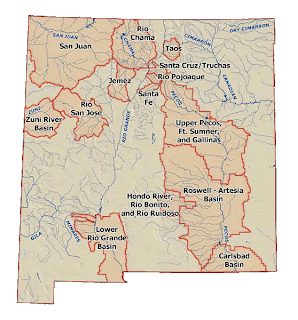
One of the central concerns of the State Engineer, and of the Utton Transboundary Resource Center (at UNM), is the public image and message of the on-going adjudication process. People tend to react negatively when they receive any kind of legal document, and it's no wonder that so many don't respond to initial offers of judgment or consent orders, so the "back end" work on this is time-consuming. Just look at the map to see the number of in-process adjudications, and this figures does not include the real beast that has yet to start, the Middle Rio Grande. I've written about Darcy Bushnell's efforts already at the Utton Center and her role in the Ombudsman Program. One of her central challenges is to facilitate public understanding of adjudication and I think this video in English and Spanish does a good job in explaining the process. Adjudication reform is also under discussion, because of the conflicts generated within and because of adjudication as ...

How the West was Won (by some), Las Vegas-style

Image
I sat in on two court meetings, overseen by a Special Master for the Pecos River (adjudications) this morning, the first on the shortage-sharing agreements in the larger Las Vegas area, the second on the Pecos River adjudication itself. Sharing a "shortage" may seem like negative accounting to some, but it has a long and rich customary history in New Mexico. I will try not to be wordy, which is difficult when you have to explain concepts like "legal threshold" (great euphemism), but it was both a dull and interesting moment to observe. These proceedings can inherently be dull because it is a discussion, most of the time, about agreements already entered into, a kind of status check so that the Special Master can observe if on-going negotiations and settlements between parties (say, Las Vegas and the regional acequias) are having their desired effect, hopefully a long-term settlement. Part A of the proceedings this morning was really about the now remanded Pueblo...