Posts

The Unsettled Waters of the American West

Image
Unsettled Waters: Rights, Law, and Identity in the American West is now under contract, and under production at the University of California Press. Release is scheduled for November 2018 and I'm excited that this first, detailed ethnographic study of water rights adjudications in New Mexico will soon see the light of day. I'm delighted that artist Charles (Chuck) Forsman allowed me to use his " Native Land ' painting held in the Fine Arts Center at Colorado College, as part of the cover design. Stay tuned! This blog will have new posts soon as the release date approaches...tentative cover copy design is below.

Waters less unruly than unsettled

Image
Back in the game for blogging! I had to take some time off to finish up the book on water rights and adjudications in New Mexico and that is now submitted to a press to be named later (don't want to count the chickens before...yeah). The book examines what we gain by tracking what water rights adjudications did to neighborly relations, in uncovering old wounds, and producing new water anxieties across the state. I'll be teasing this out over the next year or two as the book is produced and then released. For me, it's a relief that the first submission version is done and in. It almost did me in! There is something anti-climactic about working in the field, archives, and in the literature of water for 10 years and simply hitting the "send" button on e-mail to submit. I still remember having to send physical (and multiple) copies on paper for the first book. It's been a warm-ish winter and an unstable spring, with some unpredictable late winter-like storms...
It's been too long, far too long. How do I know? Because someone umm...err...let's say "borrowed" the title of my blog and would-be book. So I'm moving on to another 'trope' since a) it's been too long for me to pretend this is an active blog and b) someone moved in on this name of unruly waters. Oh well, live and learn... At least we're having a great El Ni ñ o year now... to more rain. Cheers, see you downstream.

A short radio/news story on acequias of New Mexico (H2O radio)

Image
Back in February I spoke with two lovely people behind H2O radio, Jamie and Frani. H2O radio is a new program that is focusing, surprise-surprise, on water issues. They wanted to write about the acequias of New Mexico and southern Colorado. I talked to them for a while, and then suggested many, many people they should talk to - here are the results. I hope that I have at least honored what I have learned from the people who have taught me so much since I started this work 7-8 years ago. Enjoy...

Spring updates, Hydraulic Colorado

Image
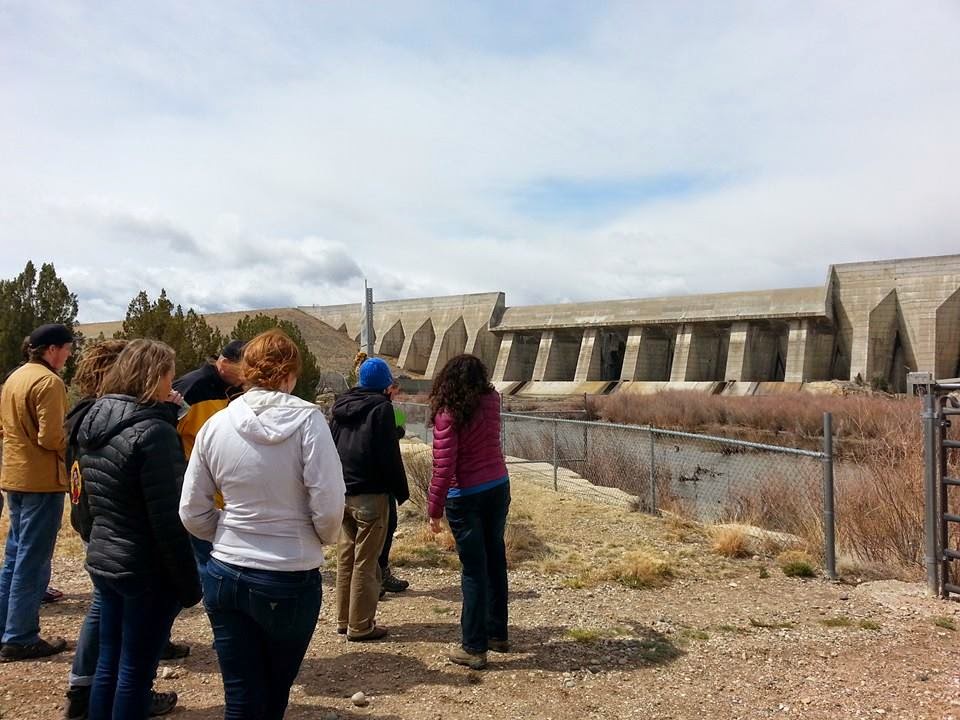
I chose to create a thematic focus of Hydraulic Colorado, for my usual Southwest Studies 272 Nature, Region, and Society of the Southwest course. Part of the motivation was to certainly force myself to explore more of the contrasts and parallels between Colorado and New Mexico water management, law, and allocation procedures. But given that it is a writing intensive class this year, I had to find a way to keep it "local" and manageable so that drafts could be developed without struggling to write on laptops and find WiFi on the road as we usually do. Day trips were the solution. Some visits included a stop at the Pueblo Reservoir , with the ever-helpful Colorado Springs Utilities folks (thanks Allison!) and their overview of the Southern Delivery System , you can see the outlet on the lower part of Pueblo Dam in the second photo, a new pipeline project to move CSU water rights out of the Arkansas River up to the Springs. It's a massive retro-fitting project, much li...

My private Idaho adjudication?

For those of you who track water adjudications, one of the more interesting ones has been in Idaho . That state has nearly completed the Snake River adjudications much to everyone else's surprise. These are handled a bit differently, obviously, from the New Mexican cases I'm more familiar with, but still - there are lessons to be learned from this approach, I think. What could NM do to speed things up? Certainly the use of geotechnologies has picked up the pace of doing the technical work - but adjudication is not just a mapping problem, it's a legal challenge, and a political morass. More on this matter later, for now, here's the full story link.

2014 - another year of drought?

Image
Grim news from the long-term NOAA forecast for New Mexico and much of the Southwest: it doesn't look good, folks. Another year of water sharing and shortages. We'll be, perhaps, luckier in Colorado only because our Fourteeners (mountains higher than 14000 ft) intercept more Pacific moisture that gives us our snowpack. But it's not likely that 2014 will snap the long-term drought plaguing New Mexico. More later, but for more on the details, see John Fleck's excellent write-up and some of the NOAA probability maps here:  http://www.abqjournal.com/337588/abqnewsseeker/nm-drought-outlook-bad-to-worse.html September 2014: Hindsight update: ENSO kicked in at the right moments this summer of 2014 and has reverted most of the extreme drought situation in New Mexico. The recent hurricane Odile rains have also helped significantly as well, even if too much water soaked into southern New Mexico. Another humbling reminder that forecasts can be useful, but completely wrong. Res...

An unruly summer of 2013 (updated)

Image
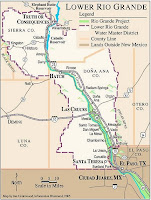
It's been a busy year and I have had little time to update, much less maintain, this little water blog on most-things-New Mexico-but-not-all. In the 8 months, much has changed in terms of lawsuits, roadblocks in the large adjudication cases in the state of New Mexico (like the Lower Rio Grande, aka the large dry colon serving sand, sediment, and scarcely much water into Texas). And yet, other aspects seem hauntingly familiar of 2012: fires, and the post-fire flooding across regions of Colorado and New Mexico. Let's lead with the larger context , drought and record or near-record low levels in the Colorado River and the Rio Grande. And this is Forbes magazine, mind you, talking about how to responsibly 'price' water in the Southwest. The Lower Rio Grande adjudication is dragging one, lurching, even as the water itself (or "wet water" as engineers hilariously call it) is drying up. While some of the stream system issues are starting to look vaguely settled ...

Water levels low, "polar bears" affected.

Image
Happy new year everyone! This mini-post is not about what you think it is. It's not some grim polar bears are affected by climate change post. Staci Matlock did, however, inform us that low lake levels across New Mexico are again affecting the January 1 human polar bear activity . Stay safe out there, it's icy. And welcome to 2013.

Pre-apocalypse water news and review for 2012

Image
As we approach (just) the end of 2012, I wanted to make sure that several water-related stories circulating in parts of New Mexico stay vivid and don't fall out of circulation. As usual I've drawn heavily from La Jicarita . None of this is "news" to the people who have posted, shared, or spread these stories - it's only a way to reflect a bit on the links between them. Those links aren't always obvious. I'll start with what seems increasingly "natural" to the water wonks and local water experts in our region of the Southwest, drought . As detailed by Kay Matthews on the newly-revitalized La Jicarita webazine, Placitas, on the NE side of Albuquerque, is just one small village dealing with the at least two-year drought of 2011-12. After last winter's La Nina low snow non-events in the Southwest, the 2012 winter precipitation season is off to a very slow start. Things look grim , with people actually praying for snow, as opposed to expecting ...

Texas water law symposium in November

Image
Hello folks, the Texas Wesleyan Journal of Real Property Law asked me to post some information here about an upcoming water law symposium. Read on, below, for more information. I'll be back within the week to update the blog, once my block 2 teaching has wrapped up here at Colorado College. The Journal is hosting a water law symposium on Friday, Nov. 9, 2012 at Texas Wesleyan School of Law in Fort Worth, Texas . F or more information about our symposium, pleas e visit http://bit.ly/ TWUWaterLaw .  

Climate change and the hydraulic-industrial complex in the American Southwest

Image
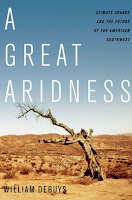
This post has much to do with an upcoming visitor to the Colorado College. In September, our so-called block 1 at the college, we'll have William (Bill) deBuys on campus, to discuss his latest book " A Great Aridness " (2011, Oxford U Press). The point of the book, as I read it and re-read it this summer, is to survey how different parts of the larger region we call the Southwest will cope under forecasted (or actually-occurring) climate changes. Surface water, forest fires, endangered species, are all grist for the mill in A Great Aridness, as Bill travels parts of the Southwest and talks to scientists working closely on these topics. The relevance in the first two classes I'll teach this year, Political Ecology of the Southwest (block 1), and Introduction to Global Climate Change (block 2), is fairly obvious. The first block, the political ecology class, is really a thematically-rotating focused seminar on various regional issues. Apart from a core text on polit...

Unruly Waters (new title for the blog)

Image
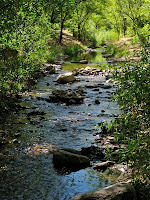
Unruly Waters is the new address, and name, for this blog. The old "donchuyspad" was just a little too creepy for a blog on water, adjudication, climate issues. New content incoming! Stay tuned...thanks for your patience. Here's some eye candy in the meantime... Photo : June 2012 pulse of the Santa Fe River, flowing once more (at least that week it was), all an experiment to create some version of a 'living river' in a city that has over-taxed this small watershed.

The cultures of water in the Southwest

Image
As a colleague and I prepare to launch block 6 (Feb 20 th start date) with our Southwest Studies 272 ( Nature, Region, and Society of the Southwest ) methods course, I am finalizing the details of our field excursion into New Mexico. Our theme will be on the “cultures of water in the Southwest.” And while sticking to New Mexico may not show all the dimensions to the theme, it certainly will cover most contemporary concerns related to water: cultural perceptions of water, water use, water rights, and also the rights of ecosystems and species. So what we have planned is visits, discussions with local and regional experts on the various cultures represented in the state. We have assigned Sylvia Rodriguez's book on Acequias , a volume largely focused on the Taos Valley experience (see the map) , as a way to illustrate the complexity surrounding water use, ritual, and place in northern New Mexico. We'll be with her, in the flesh, on March 6, as a way for the students to 'me...

New water works, a new water czar, and the same challenges ending 2011

Last post of 2011! It’s been too long, yet again. So this will be the last post for this calendar year of 2011. There are so many issues and events of interest to cover, since last August, I’m not sure where to start. So here I’ll simply start with some regional issues, first with Texas (?!), then moving on to the usual New Mexico water issues, challenges, and battles. There was also big news out of Santa Fe, namely with the appointment of a new state engineer. Finally I drop a plug or two for some books that have recently appeared that should be of interest to all residents of the Southwest if you care (at all) about water in our region. NPR had an interesting story on water issues in Texas specifically that I thought was worth sharing – see below. I’m not sure if they are “things you didn’t know” about water in the Lone Star state, but some are intriguing. Water in Texas: http://stateimpact.npr.org/texas/2011/11/15/five-things-you-didnt-know-about-water-in-texas/ The water year i...

Putting the monitoring back into "AWRM"?

Image
For this month's post, I'm choosing to focus on the state of New Mexico's " active water resource management" program , which I'm unofficially re-naming the active water resource monitoring program. Why? Read on... I'm just back from the Rio Mimbres, in southwestern New Mexico, a beautiful and verdant valley even in this horrible drought year (the driest on record for most parts of the state, serious business). In past posts, I'd made mention of the Mimbres as both fully adjudicated and already in the AWRM program that the Office of the State Engineer (OSE) runs. About eight years old as a piece of state statute, less old in terms of actual existence, AWRM has triggered controversy, grumbling, and one lawsuit that questioned its legality. On the Mimbres, the trigger was the Bounds case, and it has created real difficulties for folks on the so-called "upper Mimbres" (basically north of Rt 152 that runs E-W across the valley) with folks dow...

Return of the blog, part 68

Image
This is a long-overdue quick post to get my blogging engine running again. I'm now back in New Mexico, on the outskirts of the captial, with a spectacular view from our casita of the Jemez Mountains and its current state of smoke and fire. In the first week of July, the scene was straight out of a Lord of the Rings set of Mordor ( photo ). I'm here to not only try to write several pieces on the larger water governance, adjudication, and acequias project but also to work with one of our Southwest Studies majors and a rising senior at Colorado College , Andrew Wallace. He has chosen to look at the Aamodt adjudication, now in settlement talks with all stakeholders, and how legal pluralism is or is not visible in the original case and the run-up to the settlement itself. Legal pluralism is a concept that originates from the critical legal studies literature, as well as from anthropologists like Laura Nader who made extensive use of it in her work, that speaks to whether multipl...

Adjudication Round-table (March 18, 2011 report)

Image
Well, more than two months have gone by (again), and I'm in the position of playing a bit of catch-up for the purposes of this blog. Hopefully I can begin to re-commit to these writing activities now that stand-up teaching (always a curious phrase) is over for me at CC. I wanted to report on a fascinating, and inter-disciplinary, conversation hosted by Sylvia Rodriguez (Prof Emeritus, UNM Anthropology) this past March 18, 2011 at the Department of Anthropology at the University of New Mexico. The point of the conversation was the water adjudication process in New Mexico , putatively, but we wandered far and wide on topics ranging from ecosystem rights to water, to Powell' original "watershed" democracy proposal in the 19th century, to how other states have coped (or haven't) with the demands of a general stream adjudication. After some formal and informal introductions, our discussion started to hone in on the real issues of "why adjudication" started...

Post-settlement adjudications?

Image
This month's "acequias and adjudication" update will be old news for most of you who follow these issues closely, so apologies in advance. The point of this small post is to push through the seemingly finalized and maybe mundane details of an adjudication "settlement" and ask "what comes next?" The Aamodt ( Pojoaque Basin , NM) and the Abeyta (Taos Valley, NM) adjudications have been legally resolved through settlements funded, finally, by the U.S. Congress and the President's signature. This is good news for residents who worried about the long-term implications of these two pending lawsuits that embroiled locals, state officials, attorneys, the respective tribes, and finally, the federal agencies. Both of these lawsuits, shockingly, were older than I am, born in the late 1960s when water infrastructure and future projects pushed the state to finally file suit to document the water rights in the two water basins. You can easily find the detai...

Aamodt, Abeyta, Pojoaque Regional Water System

Image
First of all, apologies for the long interval and delay in this latest post. I had hoped to keep posting at a pace of about one comment per month, and administrative duties have taken their toll on this blog. But there's big news out from this past week, for all New Mexicans, even if the Aamodt-Abeyta settlements (for the Pojoaque Valley and Taos Valley, respectively) are supposed to be constrained to those water basins. The effects simply won't be. Funding for the settlement was approved on November 30th by the U.S. House of Representatives after already clearing the Senate, and it has money attached. The timing is tight, and frankly, lucky for those people who would fashion themselves as 'proponents' of the settlement. The legal team at the Office of the State Engineer must be relieved, if not overjoyed, that these old adjudications are seemingly put to rest. It puts to rest two of the longest running court processes in United States history, and will re-configure t...